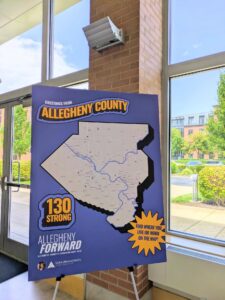
Allegheny County is in the process of updating its Comprehensive Plan, a crucial long-term framework aimed at guiding growth and investments to ensure the county’s prosperity over the next 25 years. This plan is designed to influence the future of local communities by integrating land use, infrastructure, housing, culture, open spaces, and economic development priorities across all government levels. It aims to be more than just a vision, building upon existing planning efforts to deliver a clear set of actionable steps, grounded in collaboration and designed for tangible impact.
The new plan, Allegheny Forward, serves as both a vision for the county’s future and a practical roadmap to achieve it. It establishes policies for development, conservation, and economic initiatives. Through 2026, Allegheny County will focus on developing this comprehensive plan and engaging with the community to identify issues the plan should address, methods to tackle them, and how the county can best support its partners in these efforts.
The Allegheny County community has the opportunity to create a more connected, resilient, and equitable environment for current and future generations. Allegheny Forward will utilize stakeholder and public input to pinpoint key issues and help set priorities for the plan.
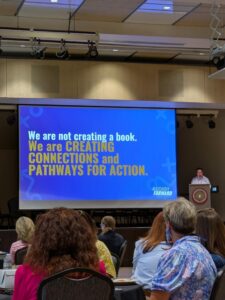
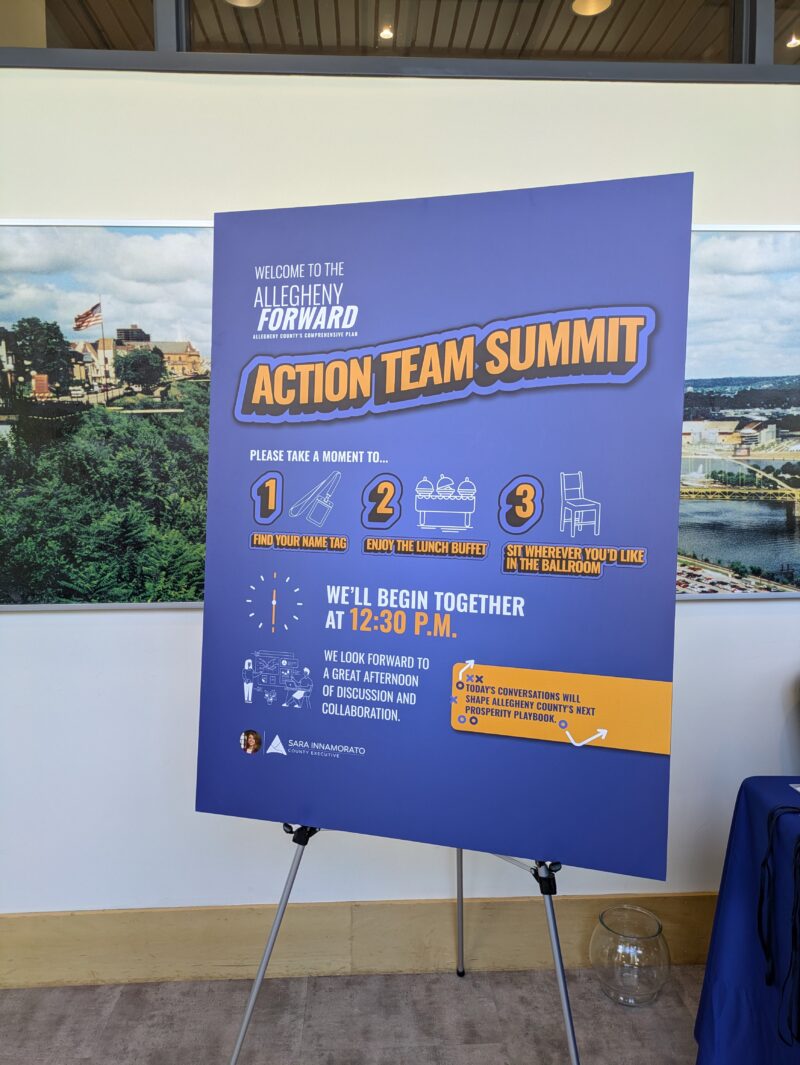
On Wednesday, August 5, the Airport Corridor Transportation Association (ACTA) participated in the first Allegheny Forward Action Team Summit. This event was an opportunity to connect, collaborate, and co-create. Leaders, practitioners, innovators, funders, and community voices came together to develop bold, inclusive strategies for the six key issues that community engagement identified as most important for the county’s next comprehensive plan to address.
The summit began with lunch and plenary remarks at noon, followed by facilitated Action Team breakout sessions. During the summit, ACTA worked with fellow participants to validate initial topic findings and begin identifying pathways for progress.
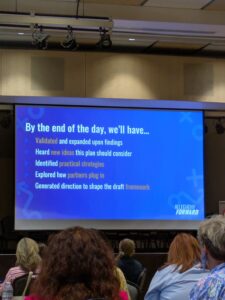
Allegheny County Executive Sara Innamorato inaugurated the summit, outlining the goals for the day, which included:
-
Evaluating and building on existing knowledge
-
Exploring strategic directions, practical paths forward, and collaboration opportunities
-
Shaping the framework for the county’s new comprehensive plan
Six critical issues were identified, forming the basis for six Action Teams: infrastructure and resilience; jobs and economic development; transportation and access; trails and connectivity; housing and neighborhoods; and parks and recreation.
ACTA joined the Transportation and Access Action Team, where the main issue was identified as limited transportation choices and disconnected systems, which hinder access to daily destinations. Representatives from SPC, PennDOT, BikePGH, Riverlife, PRT, POGOH, Mobilify SWPA, and Heritage Community Initiatives were also part of the team. Key findings included:
-
Many residents are near destinations but lack access to them.
-
Critical pedestrian and bicycle gaps are concentrated along corridors that carry regional movement, creating pinch points for those without reliable car access.
-
Transit, trails, walking, and biking should be treated as one integrated access system, not separate networks.
-
Municipal plan and policy coverage is uneven, so access outcomes depend heavily on location.
-
Car dependence imposes household, environmental, and fiscal costs, making multimodal access an economic, health, and resilience issue.
-
Allegheny County’s strongest role is setting the regional access agenda and facilitating local actions to create a connected system.
The team brainstormed the following solutions:
-
Consolidation for efficiency (e.g., corridor management services)
-
Legislative action on the state level and advocacy
-
Transit-oriented development and land use policy
-
Expanding rather than reducing transit
-
Completing all gaps within the next 25 years
-
Redefining the trail system as a cohesive superhighway
-
Establishing a countywide multimodal transportation commission
-
Increasing dedicated transit space and improving efficiency and timing
-
Enhancing safety for multimodal transportation